

FAQs on ICB
Qualifications
& Exams
Exams
Can I and how to request a Re-mark?
Yes, you have one month after your results are released within which to apply for a re-mark
But, before you jump in, here is some background……
The ICB marks over 20,000 Portfolios of Evidence and final exams every year. We have very strict procedures and quality control processes in place that ensure each paper is marked fairly, on its own merit. Papers are benchmarked against the class, and then against all learners around the country who wrote the same exam.
Your results do include a breakdown of your PoE marks and scores per question in your final exam.
If you are still not happy with your results, you have a month after they are released to apply for a re-mark. If you request this, we will retrieve your PoE from storage and an Assessor and a Moderator will review its entire contents and will write up a detailed Re-mark Report for you.
Reviewing exams is time-consuming and this re-mark process is the only way to query your results, or raise a query about the content of an exam paper.
If you would like to go ahead with a re-mark:
1. Read and understand the remark section of the Exam Policy which explains the re-mark process in detail.
2. Complete the Application for Re-mark form (Find the form here on the website: (Form is available in the Download Library on the website)
3. Pay the Exam Re-mark and Examiners’ Report fee within one month of your results being release. (The current fee can be found on the fees list on the website)
4. Submit the remark form and Proof of Payment via our support page on our website: contact us
An assessor and a moderator will review your entire Portfolio of Evidence and compile a detailed Re-mark Report for you. This will take about 28 days.
An ICB agent will contact you once the review report is available.
Can I get my PoE or exam script back?
We understand that there is a real desire for students to get papers back after marking, but this is not the practice of most external examination bodies.
Our Academic Team has reviewed this request previously, and found that in most cases, when this issue is raised, it is because of these 3 reasons:
a. the student did not do well, and/or
b. did not get proper support from a college and/or
c. did not use the PoE system correctly.
We are one of the few institutions that have a PoE system, and the whole point of that is to facilitate continuous learning. The PoE system allows a learner 5 opportunities prior to the final exam to evaluate their knowledge. If this is done together with a college, who reviews these assignments and tests with the student, gaps in knowledge are identified early, and addressed.
With the on-line assessments, test results are given immediately. Students should not progress to the next section of work, until there is adequate knowledge.
Furthermore, when final results are issued, these are extremely detailed, to give a student a good breakdown. Here again, this is substantially more than most other external examination bodies, who only give one final mark.
If the PoE system is used correctly, a student will not receive any significant additional value in reviewing their marked scripts, that they could not get from the information already supplied.
NB: To uphold the reputation of ICB graduates, past and future, we want to ensure that our students are not just able to repeat information in an exam or be good at writing exams, but also gain a proper understanding of content and the ability to put that knowledge into practise.
Any student that takes “shortcuts” and enters the workplace without the actual competency to do the job, is risking the reputation of ALL ICB students.
If you feel that there has been an error in the marking, please see the FAQ on how and when to apply for a remark.
Changing exam type between ONLINE and PAPER exams
It is possible to postpone an exam from a paper version to an online version or vice versa.
PAPER EXAMS: These are hard copy exam papers that are completed by students at their Training Centre or an ICB Exam venue.
ONLINE EXAMS: These are online exams that are completed on the Macci platform and proctored by the ICB.
Specific rules apply to both types of exams. Please make sure that you have read the ICB Examinations Policy and the Technical specifications for Online Exams before you decide on your exam type.
IF I AM BOOKED FOR A SPECIFIC EXAM TYPE CAN I CHANGE THE TYPE?
Once the exam has been booked and paid for, the exam type CAN be changed, this means that you can switch from one to the other.
IF I AM BOOKED FOR A SPECIFIC EXAM TYPE, CAN I POSTPONE TO A DIFFERENT TYPE?
The student portal is programmed to automatically postpone your subject to the next available date. The next available date can be either an online exam or paper exam.
CAN I BOOK FOR DIFFERENT EXAM TYPES AT THE SAME TIME?
Students can be booked for multiple types of exams.
E.g. You could be writing on an online exam for BKTB in April but also be booked to write BUSL at an ICB venue in July.
Remember that when booking your exams on the student portal, ALL online exams are booked to the ONLINE EXAM VENUE and paper exams are booked to ICB EXAM VENUES. This is to ensure that you are clear on what type of exam you are writing and where.
Exam Session Duration and Times
All exam sessions (online and paper) are 3 hours long, plus an additional 30 minutes for setup and reading time.
- Paper exams take place from 09:00 to 12:30.
- Online exams can be started any time between 09:00 and 13:00, but all sessions will automatically close at 16:30.
- RPL and RTAP submissions must be completed by 13:00.
Exam Venues (Paper Exams for Self-Study and Distance Students)
2026/2027 Exams
The following ICB venues offer paper-based exams only, and each has limited seating. Be sure to book early to secure your place:
- Johannesburg: Sandton IBTC (78 seats)
- Johannesburg: Benoni Central Methodist Church (108 seats)
- Cape Town: Graduated House, Century City (35 seats)
- Durban: Glenwood Presbyterian Church (50 seats)
Please note: These venues are relevant for the Paper Exams (Distance and Self Study Students only)
How to book for an exam
- Distance students, you will do your exam registration and payment on the Student Portal
- Classroom students, your training centre will do your exam registration for you.
The below article details how Distance and Self-study students book exams on the Student Portal. A link to the student portal can be found on the ICB website www.icb.org.za at the top right of the page.
Book an Exam
Before you can book for an exam, you must register on the student portal and select a qualification.
The successfully registered student can now book an exam. This is done by clicking on Enter Assessment on the left-hand side of the screen.

The next step is to choose / select the subject for which the student wishes to book an exam. This is done from the drop-down menu. After selecting the subject, the student then needs to choose an exam venue from the drop-down menu. Once the venue has been selected, the student must click on the Search for Available Assessment Dates button. This will display a range of dates for which the exam is available. The student then needs to select the preferred exam date.

To complete the process, click on Add to Basket next to the preferred exam date and venue.
Review Basket and Checkout
Students will be asked to review the contents of their basket. If an exam has been selected in error, it is possible to remove it by clicking on the X next to the item. If the exam selected is correct, click on Checkout.

NB: Once an exam is booked, no changes or cancellations will be accepted!
Submit Assessment Booking
Students will be asked to give a final review of their basket. It is necessary to click on the Next Step button in order to progress through the final checks. In addition to a final review of what is in the basket, students will need to check that the billing address is correct, select the method of payment (credit card, debit card or EFT) and confirm the order. Once everything has been confirmed, students need to click on Submit in order to proceed to the payment.

Making a Payment
Payments are made through the PayFast system. The payment is affected using the means that the student has chosen:
- Credit Card
- Debit Card
- EFT
- Mobicred

Once the payment has been processed, the student will have access to the PoE.
WHAT DOES IT MEAN WHEN I GET A POP-UP MESSAGE WHEN I TRY TO BOOK?
- This could mean that the venue has been closed for the next exam session and that no exams will be available for booking at that venue. Remember to check the ICB Website for available ICB Exam Venues.
OR - This could mean that no exam dates have been opened for this particular subject. Remember to check the subject roll out schedule for your subject and also to check the ICB Exam Timetable to ensure that there are dates coming up for your subject.
VENUE CAPACITY LIMITS
ICB Exam Venue have capacity limits. This means that once the venue has reached the capacity limit that no further exams can be booked or postponed to that venue.
Please ensure that you get your bookings in as early as possible to ensure that you reserve a seat for yourself.
How to check Exam Bookings and get Exam Confirmation Letters
2 WAYS to CHECK EXAM ENTRIES
1. As soon as you enter for an exam, you will receive an email with confirmation that we have received your entry. If you don’t receive this, please follow up immediately, so that we can find any gremlins!
2. Distance and self study students can pop onto the student portal and go to the View My Exam tab. Your upcoming exams will be listed here. You can also use the blue button to download an exam confirmation in pdf format. While classroom students can check with their training centre.

When you did you original booking, you would have received a booking confirmation via email. If you did not receive, please check the following;
1. Your spam folder. Sometimes, emails are automatically marked as spam
2. Check your connection to see whether other emails are indeed reaching you
3. Check your mailbox and make sure it is not “full”
4. Ensure that your email address is correct or has been updated on our system. Sometimes people change from employer which impacts their email address which they used to register with initially.
Should you have checked all the above and it still does not reach you, please contact us via this link; https://www.icb.org.za/contact/
How to do a voluntary Postponement of an exam? (with fee)
Students are able to apply for a voluntary postponement – rules and fees apply.
CLASSROOM STUDENTS
Students who study through a Training Centre must contact their Training Centre to request a postponement from the ICB.
The ICB will manually process the postponement and confirmation of the new exam date will be provided to the Training Centre.
DISTANCE / SELF STUDY STUDENTS
Distance and self study students are able to process paid postponements on the student portal. Remember to check the timetable to ensure that there are future dates available for the subject.
This functionality on the student portal has been updated to show the following:
1. Students can now postpone between exam types E.g. Paper to online, online to paper
2. Students can select from multiple postponement date options
3. Students can select an available venue for paper exams
Students will not see postponements available for a booked exam if this subject was already previously postponed for any reason. You can contact support@icb.org.za with any related queries.
STEPS TO FOLLOW ON THE STUDENT PORTAL:
STEP 1:
Students can complete the postponement on the student portal in the “My Exams”tab.
STEP 2:
In the “My booked exams” table, you will see a list of exams you are currently booked for and be able to view confirmations for these.
Example:

STEP 3:
In the next table “My postponement options” you will see all future exam dates that you can postpone your booked exams to.
You must click on the “postpone” button next to the date you want to postpone your exam to.
Example:

STEP 4:
Once you have clicked “postpone”, a list of venues will become available to choose from.
For online exams, only one venue is applicable which is “Online Exam (on Macci)”.
For paper exams you will see a list of ICB venues. If you don’t see a venue, this means that there are either no exam dates available at the venue or that the venue has already reached capacity. You will only see venues where an exam date and seat are available for the subject.
Check the date you are postponing from and to and that the venue is correct.Click “Add to cart”

You will see the following message that the postponement has been added to your cart.

STEP 5:
When you have added your postponement exam to cart, click on “Check out” at the top of the page.

Your transaction will be visible in the cart.

Now you can click “Next Step” until you get to Step 3.
When you get to “Select payment method”, pick the relevant payment option
Once payment selected, click “Next step” and tick the confirmation box and submit.

I missed the exam booking deadline
Should you have missed the deadline to enter for an exam you can still enter a week after closing date by submitting a request for late exam entry, which will be charged a late entry fee. Please click here to see all fees.
What you need to do is complete the Contact us page on our website and clearly indicate the following;
- Attach the proof of payment of the exam fee and late entry fee.
- Please include the below in the text block asking to tell us more about how we can help you:
- What exam type: Paper or Online
- If paper: State venue where you would like to write
- Date of exam
- Subject
- Your name / surname and student reference number
Important Exam Information
- All students can choose between paper-based or online exams (where available).
- Exam timetables, venues, and times are subject to change at ICB’s sole discretion.
- ICB venues have limited capacity, so book early to secure your seat.
- All exams are conducted in line with ICB Policies, available on the ICB website.
- Before booking an online exam, students must ensure they have the required resources and setup in place. Refer to the Knowledge Base for full technical requirements.
Not passing on the first attempt
- If students do not pass on the first attempt, they can re-register for a new PoE and exam attempt.
- If students re-register within the same academic year, they do not need to redo a new PoE.
- Students have the option to request additional attempts at the tests and assignments they however must be completed before the PoE due date.
- The Academic year runs from 1 April of the current year to the end of March of the following year.
Note: The same PoE (and results) will be used for your next exam unless you have booked an exam in the new Academic Year – then a new PoE will need to be completed.
Paper-Based vs Online Exams - How do they differ?
ICB students have a choice between sitting either paper-based or online exams. The exam timetable is divided between these two types of exams and affords students more opportunities to write exams.
Paper-Based Exams
Paper-based exams are sat at an exam centre. The centres are approved ICB exam centres. These centres are either ICB accredited training centres or at venues booked by the ICB specifically for exams.
Exams at centres are proctored / invigilated. The invigilators are trained in the ICB’s exam policies and procedures. On entering an exam venue, students are required to provide proof of identity. This proof may be in the form of:
- A green-barcoded ID book
- An official ID card
- A passport
- An official temporary ID document
Students will not be permitted to sit an exam if valid proof of identity is not supplied.
Paper-based exams are three-and-a-half hours in duration. The first half-hour is reading time where the invigilator will go through the exam rules. The exams commence at 9:00 in the morning and finish at 12:30. A student who arrives more than thirty (30) minutes after the start time of the exam will not be permitted to enter the exam venue and will not be permitted to write the exam.
At the end of the exam – or when the student is done writing – the exam paper and answer book is submitted to the invigilator.
Online Exams
As with the paper-based exams, the online exams take place on specific dates and at specific times. In contrast to the paper-based exams, online exams can be started any time from 9:00 to 13:00 on exam day and automatically closes at 16:30. Thus, the online exam is the same time duration as the paper-based exams.
Take note that ALL online exam sessions for the day will automatically close at 16:30.
Students are required to log into the exam between the stipulated times. A student who attempts to log into the exam more than thirty minutes after 13:00 will be considered as late and will not be granted access to the exam.
The type of questions in the online exams will be similar in nature to those questions in the paper-based exam. Thus, students can expect:
- True or False
- Multiple Choice
- Gap-fill
- Extended writing
Online exams are proctored. This is done through an online system that makes use of the webcam on the student’s computer as well as tracking software. The webcam is used for facial recognition and it tracks eye-movement. The tracking software notes any activity on the student’s computer specifically related to activity outside of the exam page.
At the end of the exam, the student submits the exam paper by clicking on the “Submit” button. Where the finish time of an exam is reached and a student has not clicked on the “Submit” button, the online system automatically submits the exam.
Students doing the online exam are required to complete the post-exam survey.
Online exams have specific technical requirements. Students need to familiarise themselves with these requirements before booking an online exam. The Technical Systems Check in your PoE also need to have been passed to be able to write the online exam.
The format of the online exam will be very similar the paper based exam. The main difference will be the platform which will be used to capture your answers. One is paper and the other will be a computer.
The length and the marks of the paper may be adjusted to allow for adequate time needed to capture answers online.
PoE Deadlines
Students need to have completed their PoE by the PoE due date as per the exam time table to be allowed to write the exam (paper and onlne). This is about 1 week prior to final exams, to allow the ICB to perform certain administration functions prior to the exam and for students to focus on revision and exam preparations. Any student who has not completed their PoE by the PoE due date AND in full, will not be permitted to write the final exam.
In Summary
|
Paper-based Exams |
Online Exams |
| Duration: three-and-a-half hours | Duration: three-and-a-half hours |
| Venue: exam centre | Venue: of a student’s choosing |
| PoE: completed online and submitted by the due date as per the timetable | PoE: completed online and submitted by the due date as per the timetable |
| Invigilated / Proctored: yes | Invigilated / Proctored: yes |
| Question Types: quiz-type and extended writing | Question Types: quiz-type and extended writing |
| Submission: to invigilator | Submission: online |
| Exam times: 9:00 – 12:30 | Exam times: Anytime from 9:00 to 13:00. All sessions automatically closes at 16:30 |
Fees
Easy Payment Plans with Mobicred
Mobicred is a simple & convenient credit facility that allows you payment terms to make one single monthly payment for all your purchases with a revolving credit limit – allowing you to spend whatever you re-pay.
How to pay your ICB FEES with Mobicred
- Step 1.
Register on the Student Portal. - Step 2.
When paying, choose Mobicred as your payment method under the PayU payment option. - Step 3.
Apply for a Mobicred account online, or existing customers sign in to your Mobicred account. - Step 4.
Get access to your ICB PoE immediately, and pay your Mobicred instalments when due.
Visit Mobicred for more information.
*RCS is a registered Credit and authorized Financial Services provider. NCRCP 38/ FSP 44481
Important information about Fees
- All fees are non-refundable, quoted in South African Rands, and are subject to change without notice. Fees include 15% VAT (for South Africa) and bank charges for international payments.
- If you’re registering for your first exam in a calendar year, the annual student registration fee is required.
- If you cancel an exam, the fee is non-refundable. However, you may postpone an exam once to the next available date, provided we receive your postponement fee and all required information by the due date. Please refer to the ICB Exam Policy and for full details.
- Course materials or textbooks. The ICB is an External Assessment Body, and does not provide tuition or learning support. Please refer to your tuition provider or purchase materials directly from EDGE Education.
Full Terms and Conditions can be found here
Payment Methods
- Credit or Debit Card
Pay securely with your credit or debit card via the ICB Student Portal. - Instant EFT
Make a real-time EFT payment directly through the ICB Student Portal. - Mobicred (Buy Now, Pay Later)
Choose Mobicred as a payment option during checkout to split your fees into manageable monthly instalments. - EFT or Bank Deposit
Make a direct bank transfer. Please use your ICB reference number or South African ID number as the payment reference.
Banking Details:
Bank: FNB (First National Bank)
Account Name: The Institute of Certified Bookkeepers (Pty) Ltd
Account Number: 50262418757
Branch Code: 201509 - No Cash Payments
The ICB does not accept cash. If you must pay with cash, deposit it at an FNB branch and email us the proof of payment. - No Debit Orders
The ICB does not offer debit order payment options. - Corporate or Employer Payments
If your employer or sponsor is covering your fees, ask us for a formal quote. They must use your ICB reference number or ID number as the payment reference.
Note for Foreign Students:
If this is your first payment to the ICB, please contact us to obtain your payment reference number.
What's excluded from the fees
- Changes to your chosen exam date (e.g. voluntary postponements)
- Exam re-bookings
- Training material
- Tuition
What's included in the fees
- Access to ICB Online (MACCI), your digital learning portal
- A digital Portfolio of Evidence (PoE) with 3 assignments and 2 online, auto-marked tests
- Immediate access to your PoE after booking clears
- Exam readiness pre-check for online exam students
- Online exam on exam day with full technical support from the ICB team
- Venue fees included for paper exam students
- Exam marking and moderation included
- Digital certificates for all subjects passed
- Transcript of results downloadable from the Student Portal (self-study and distance students) or via your training centre (classroom students)
- Printed certificates couriered to a Paxi closest to your physical address or Training Centre
- One free postponement for qualifying cases (e.g. illness)
Who will do the payment entry
- If you are studying through a classroom-based training centre, your college will handle your exam entry and pay your ICB fees on your behalf.
- If you are a Distance Learning or Self-Study student, you are responsible for paying your fees directly via the ICB Student Portal.
FREE Computer Course
Can organisations or companies get involved?
Yes. ICB partners with organisations through Corporate Social Investment (CSI) initiatives to bring digital skills training to communities.
Do I need any computer experience?
Not at all. This programme is designed for complete beginners. If you’ve never used a computer before, you’re in the right place.
Do I need my own computer?
Access to a computer (or shared device at a school, library, or community centre) is recommended to complete the training.
How do I register?
Simply complete the online registration form on this page. You’ll be guided to create your account and get started.
How is the course delivered?
The training is completed online via the MACCI platform, allowing you to learn at your own pace.
How long does it take to complete?
The course is designed to be short and practical, so you can quickly gain useful skills. Completion time depends on your pace.
Is this really free?
Yes — this is a fully funded community initiative by ICB. There are no hidden costs to access the basic computer skills training.
What happens after I finish?
This is just the beginning. After completing the course, you can:
- Progress to ICB qualifications
- Work towards Professional Certificates
- Build skills for employment and further study
What will I learn?
You’ll learn essential, practical digital skills, including:
- Basic computer use
- Working with files and simple programs
- Using the internet and email
- Everyday skills for work and life
Who can apply?
Anyone can register, including:
- Job seekers
- Students
- Young people starting out
- Individuals with little or no computer experience
Why is ICB offering this for free?
This initiative is part of ICB’s commitment to:
- Uplift communities
- Improve access to education
- Create pathways to employment and opportunity
Will I receive a certificate?
Yes. Once you complete the programme, you will receive an internationally recognised certificate endorsed by IQB.
General
Can I get past exam papers or my previously marked exam paper?
Past papers are not available because if outcomes change, past papers will be outdated – and we need to protect the credibility of the papers.
ICB focus is on learning. The goal of exams is to assess understanding of the material and not just get a grade! By not returning marked papers, the emphasis remains on the feedback and learning process rather than focusing too much on the marks.
Also, if marked papers were distributed, students may share answers or questions with others, which then totally disregards academic integrity. This could give students an unfair advantage and again compromise the integrity of the exam.
Your course materials (which do contain sample questions) and the ICB Assignments and Tests in your PoE will prepare you for the questions in your final exam.
ICB prides ourselves as an organization that by way of our Portfolio of Evidence (PoE) that sets us apart from our competitors and our rigorous exam process. Our students enter the workplace with a well respected and credible and internationally endorsed certification as opposed to just learning to pass an exam paper.
Please speak to your training cntre if you feel you need extra help.
How to complete the ID Verification process?
This is a security process which requires all students to upload a copy of your ID/Drivers license/Passport as well as a profile picture of yourself to the student portal.
This process only needs to be completed once – provided that the verification is successful.
On the student portal, you will see a pop-up requesting you to upload your ID/drivers/passport license and profile Photo.
HOW TO COMPLETE THE ID VERIFICATION PROCESS:
1. Step 1: Log onto the Student Portal – Click on Update my details and then ID Verification

2. Step 2: You will see an upload screen.

a. The size of the files you can upload cannot be larger than 3MB.
b. The file types you can upload are: jpg, jpeg or png.
3. Step 3: You need to upload specific photos that are going to be compared to each other for security verification.

1 X PROFILE PICTURE
a. You must upload a clear profile photo of your face. (Showing head and shoulders only)
b. You must look directly at the camera and have appropriate brightness and contrast – no filters.
c. The photo must be of you alone (no objects, toys, pets, other people, etc)
d. Your face must not be covered and your eyes must be open.
e. Your face must not have face paint or decorations on it.
f. You cannot where headgear.
g. If you wear glasses, the lenses must be clear and no flash reflection must be seen on the glasses.
g. Photos must be in colour.
1 X PHOTO OF ID DOCUMENT:
Examples:


a. A clear copy of your ID document or Drivers licence must be uploaded.
b. The image must clearly show your photo that will be compared to your profile photo.
c. The image must clearly show your ID details that will be compared to your details on the ICB database.
d. Important: The document you upload a copy of must have the same details that you have used on your student profile. You can check these on the student portal.
e. If you are not a South African citizen, you can upload a clear copy of your Passport or equivalent ID that has a clear photo of you on it. Ensure that the details used on your student profile are the same as the document you are uploading.
IMPORTANT: YOU MUST UPLOAD THE CORRECT IMAGE AT THE CORRECT PLACE.
I.E. YOUR PROFILE PICTURE MUST BE UPLOADED AT THE PROFILE PICTURE SECTION AND YOUR PHOTO OF ID DOCUMENT MUST BE UPLOADED AT THE PHOTO OF ID DOCUMENT SECTION.
Once you have added your Profile Picture and Photo of ID document, click on the Upload button:


4. Step 4: Verification process
When your documents have been uploaded, you will receive a confirmation email. This email lets us know that you have uploaded documents for verification.

This is an automated response from the ICB Support desk that will allocate a ticket number for the ID verification request.
An ICB agent will complete the ID verification process by comparing your Profile picture to your ID copy.
SUCCESSFUL VERIFICATION:
If the verification is successful, you will receive an email and the student portal will show that you have successfully completed the ID verification process. The ID Verification tab will also disappear.

UNSUCCESSFUL VERIFICATION:
1. If the verification is unsuccessful, you will receive an email to inform you of the issue and what steps you need to take. This will generally require a re-upload of documents. You will continue this process until the verification is successful.
2. If for some reason a successful ID verification process has to be reversed, you will receive an email with the relevant details.
How to update my personal or training centre details with ICB
Students can update their details on the Student Portal.
Note: Certain information such as your training centre, your name, surname and ID number cannot be edited for security reasons. You will need to contact ICB directly, should there be any changes to this. Log a ticket on our contact us page. Please include a copy of your ID for name changes.
For the rest of your details, you can check and update most of your details on the student portal.
Navigate to the “Edit my Details” menu.

Click “Edit my details” in the top right corner. This will activate the fields so that you can edit them.
Once you are satisfied with the changes you’ve made, select the “save” button to compete. You will receive an email confirming the changes. Please make sure that you receive this email, so that future emails reach you too!
I did an ICB course long time ago, can I continue?
Yes, there is currently no time limit on ICB courses.
Even if you passed just one subject, a while back, you can just start from where you left off. Or even move on to the next level automatically.
- Distance and self-study students can log onto the Student Portal, and check your past progress.
- Then go to the ICB website, and connect with any Training Centres to see what tuition style will suite you
- Classroom students can get in touch with their Training Centre or contact the ICB for assistance in continuing their studies
Unable to login to the Student Portal or Macci?
STUDENT PORTAL
Important to remember:
- Do not try and access the portal on your mobile phone. It works best on a Desktop
- The portal only currently works with SA ID numbers. Foreign students must contact the ICB offices for assistance
- Even if you are a past or current ICB student, and you have not yet used the Student Portal, you MUST register on the portal first to create a login profile.
Steps to follow:
- Go to the Learner Portal (link from www.icb.org.za) and click the REGISTER button.
- Fill in the form and submit it.
- An error message will come up, saying you are already registered. This just means that you are already known to the ICB as a student.
- Stay on that same screen and hit the RESET PASSWORD button, and follow the instructions.
- You’ll be sent a password, which completes your Learner Portal registration process. Use this password to log in to the portal.
- If this does not work for you or you have changed your details at some point, contact ICB Support for assistance.
If you still need further assistance, have look at the ICB STUDENT PORTAL USER GUIDE for more information.
MACCI
First make sure that you are trying to log onto the Macci platform and not the Student portal.
You will see this login page:

Forgotten username:
If you have forgotten your username then you can refer back to the email you received when you registered on Macci for the first time.
Forgotten password:
You would have changed your password when you first logged in, but if you have forgotten what this was, you can click on the “Forgotten your username and password?” tab on the login page (as shown in the image).
This will ask you to add your username or email address to reset your password. An email will then be sent to you with a new password.
No Email received:
You will only receive a login details email for your digital portfolio when you are registering for your FIRST digital portfolio. You will not receive a login email for any additional digital portfolios and will need to use the same login details to access these.
If you are a distance student and have registered for a digital portfolio, you will only gain access to these once your payment has been processed by the ICB. Once this has been done, you will be able to access Macci and see the portfolio you have registered for on your profile.
If you are a college student, you will receive immediate access to your portfolio once it has been booked by your college. Please note that you will receive no information via email if your email address is incorrect with your college. You need to make sure that they have your correct email details before they register your digital portfolio.
NB: Remember that all communication will go to the email address you used to register on Macci.
If you have changed your email address but not updated this with the ICB, then you will not be able to reset your username or password and will not receive any communication. You will then need to contact the ICB directly and or update you email address on the student portal.
Important to note: Please make sure you use the latest version of Chrome. Take note that the support for older versions of Internet Explorer has ended. This means that Microsoft no longer provides security updates or technical support for old versions of Internet Explorer (Internet Explorer (IE) 10 and older), which can directly impact the performance of your browsers. Regular security updates help protect devices so upgrading and staying current is important.

Will I find employment after doing an ICB Qualification or Professional Certification?
Looking to secure employment?
We often get asked the question….. Will I get a job after doing an ICB qualification and/or Professional Certification?
We cant give a guarantee, but we can tell you what we know. 1000’s of students study ICB each year, and there are many many employment opportunities. Every single business needs a bookkeeper! It does not matter how big or small, or in what industry, every business needs someone to do their books.
Many bookkeepers then go on to be very successful Financial Managers.
Here is a great article about why it is a good idea to study bookkeeping: https://www.icb.org.za/6-reasons-to-study-a-bookkeeping-course/
Getting Started
How soon do I get my results?
About 7 weeks after your final exam. Distance and Self-Study students can view results in the Student Portal. Training centre students will receive results from their training centre.
Are online exams also done on MACCI?
Yes — if you choose to write an online exam, it will be done through MACCI.
How do I access my Portfolio of Evidence (PoE)?
Once you have booked and paid for an exam, your PoE will be created on MACCI automatically.
First time Macci users will receive an email with login details and current Macci users will use their existing login details to access the PoE.
How do I progress to my next professional certificate?
For Distance and Self-Study students, once you pass a professional certificate, you can book your next exam on the Student Portal. Your PoE for the next professional certificate will be created on MACCI after your booking/payment.
Classroom-based students must book through their Training Centre.
If I study through a Training Centre, do I still use the Student Portal?
Yes — Your Training Centre will register you and may manage your exams, but you are required to login and verify your ID.
Key things to note
- You can study full-time or part-time or self-study
- You can take as many or as few professional certificates at a time as you like
- All assessments (PoE and online exams) are on MACCI. Paper exams are at a venue.
- All exam bookings and registrations for Distance and Self-Study students happen via the Student Portal. (Classroom-based students book through their Training Centre)
Steps to Get Started with a Training Centre
Step 1: Choose a Training Centre
-
Browse our list of ICB Training Centres
-
Select the study mode that suits your life
Step 2: Enrol & Start Studying
-
Sign up with your chosen training centre
-
Receive tuition, support, and materials
-
Get your PoE
Step 3: Attend Classes & Study
-
Follow your class timetable
-
Ask questions, complete tasks, and revise regularly
Step 4: Prepare & Write Exams
-
Complete your PoE
-
Review with help from your training centre
-
Write your ICB exam
Steps to Get Started with Self Study
Step 1: Register with ICB
- Sign up on the ICB Student Portal
- Select your qualification
- Select your subjects
- Book your exam dates
- Pay your exam fees
- Receive your Portfolio of Evidence (PoE)
Step 2: Access the Curriculum
- Download subject syllabi from the ICB Curriculum Statements
- Understand the topics and skills you’ll need to cover
Step 3: Plan Your Study Approach
- Learn your way: Textbooks | Online videos | Study groups | Practice exercises
Step 4: Source Your Learning Material
- Buy new or second-hand books
- Find online resources or tutoring
- Use the ICB Student Support Facebook Group
Step 5: Prepare & Write Exams
- Work through your PoE
- Stick to your schedule
- Write your ICB exam
What is MACCI?
MACCI is ICB’s online learning platform. You will complete your Portfolio of Evidence (PoE), all assignments, tests, and online exams on MACCI — whether you are studying through a Training Centre or as a Distance or Self-Study student.
What is the ICB Student Portal used for?
The ICB Student Portal is where you:
- Register as an ICB student and get your student number
- Register for a course (for Self-Study and Distance students)
- Book and pay for exams (for Self-Study and Distance students)
- View payment history and invoices (for Self-Study and Distance students)
- View results (for Self-Study and Distance students)
- Download results reports (for Self-Study and Distance students)
- Download digital certificates (for Self-Study and Distance students)
- Book and pay for voluntary postponements (for Self-Study and Distance students)
- Pay registration fees (for Self-Study and Distance students)
- View qualification and subject progress
- Verify ID’s
MACCI
How MACCI works
- Register via the Student Portal. Self-study and Distance learners register themselves, classroom-based learners are registered through their Training Centre.
- Pay the relevant exam fees
- Once booking clears, access your Digital PoE on MACCI
- Complete PoE on desktop/laptop with Chrome
- Some work can be done offline; uploads/downloads need internet
- Final exam can be done online (stable, fixed-line internet required) or at a venue
How to install Chrome or update to the latest version on your PC
Students are to ensure that they make use of the latest version of Chrome as their default browser. An outdated browser, i.e. internet explorer will impact the performance of the activities on MACCI. The ICB cannot assist with any technical queries if it is found that the student is using an outdated browser.
All assignments, tests and exams must be completed on a laptop or desktop as these are interactive activities that perform best on these devices.

How to install Chrome on your PC:
Google Chrome is a fast, free web browser. Before you download, you can check if Chrome supports your operating system and you have all the other system requirements.
INSTALL CHROME ON WINDOWS
- Download the installation file.
- If prompted, click Run or Save.
- If you chose Save, double-click the download to start installing.
- Start Chrome:
- Windows 7: A Chrome window opens once everything is done.
- Windows 8 & 8.1: A welcome dialog appears. Click Next to select your default browser.
- Windows 10: A Chrome window opens after everything is done. You can make Chrome your default browser.
If you’ve used a different browser, like Internet Explorer or Safari, you can import your settings into Chrome.
Can’t install Chrome because of S mode
If you can’t install Chrome on your Windows computer, your computer might be in S mode. If you want to download and install Chrome, learn more about how to exit S mode. You can also learn how to fix problems installing Chrome.
INSTALL CHROME ON MAC
- Download the installation file.
- Open the file called “googlechrome.dmg.”
- In the window that opens, find Chrome
 .
. - Drag Chrome to the Applications folder.
- You might be asked to enter the admin password.
- If you don’t know the admin password, drag Chrome to a place on your computer where you can make edits, like your desktop.
- Open Chrome.
- Open Finder.
- In the sidebar, to the right of Google Chrome, click Eject
 .
.
INSTALL CHROME ON LINUX
Use the same software that installs programs on your computer to install Chrome. You’ll be asked to enter the administrator account password.
- Download the installation file.
- To open the package, click OK.
- Click Install Package.
Google Chrome will be added to your software manager so it stays up-to-date.
SYSTEM REQUIREMENTS TO USE CHROME
Windows
To use Chrome on Windows, you’ll need:
- Windows 7, Windows 8, Windows 8.1, Windows 10 or later
- An Intel Pentium 4 processor or later that’s SSE3 capable
Mac
To use Chrome on Mac, you’ll need:
- OS X Yosemite 10.10 or later
Linux
To use Chrome on Linux, you’ll need:
- 64-bit Ubuntu 14.04+, Debian 8+, openSUSE 13.3+, or Fedora Linux 24+
- An Intel Pentium 4 processor or later that’s SSE3 capable
FIX PROBLEMS ON CHROME
- Try uninstalling Chrome and reinstalling it to fix problems with your search engine, Flash, pop-ups, or Chrome updates.
- Fix problems installing Google Chrome
- Fix “Aw, Snap!” page crashes and other page loading errors
USE THE LATEST VERSION OF CHROME
Due to updates to Chrome’s p2p translation technology and other regular improvements and upgrades to the browser, it is essential to ensure that you are using the latest version of Chrome to use Macci functionality.
In order to ensure you are using the latest version of Chrome or how to update this if needed, follow the steps below. The process should only take a few minutes to complete.
STEP 1:
- Click on Chrome to open a new tab.
- Click on the 3 dots at the top right of the screen.
- Next, select Help and click on About Google Chrome.

STEP 2:
- Chrome should start updating immediately if an update is required.

STEP 3:
- When Chrome has updated, click on Relaunch for the update to take effect.

STEP 4:
- The below message will show if Chrome is updated. If you see this after doing Step 1 then an update is not necessary.

How to Register
- Self-Study and Distance learners: Register via the Student Portal
- Classroom learners: Training centre handles registration
- Training centres: Register via the Provider Portal
Important info about MACCI
- All portfolios are 100% digital (as of April 2020)
- MACCI is not a learning platform – your training centre still provides academic support
- All students (classroom or distance) use MACCI
- Exam results:
- Distance learners: via student portal
- Classroom learners: via training centre
What you get with MACCI
- Access to your subject Digital PoE (Portfolio of Evidence) immediately after booking clears
- Step-by-step structure and due dates built in
- Format previews for better exam preparation
- Live progress tracking with checklists
- Instant test results and visible PoE scores
MACCI Assess
Can assessments be fully customised?
Yes — every assessment and KPI questionnaire can be tailored to your business needs.
Can we issue certifications and track CPD?
Yes — optional certification and CPD tracking is built in for compliance and professional development.
Is the platform secure?
Absolutely — all tests are delivered online with full data privacy and secure access.
Is this suitable for small and medium businesses?
Yes — the platform is affordable, simple to implement, and scalable.
What industries can use this platform?
From finance, insurance, and real estate to healthcare, retail, hospitality, and contact centres — any sector that needs structured assessments can benefit.
Online Exams
How to take a screenshot
In the CPBK Assignment and Online exams, you are required to take screenshots – in other words, a ‘photo’ of what is currently on your computer screen (a screenphoto or screenshot).
A FULL screenshot is always required. This means that the entire screen (including top and bottom tool/task bars) must be included in the screenshot.
Please follow the instructions in your assignment on how to name files correctly for submission.
In Windows: (Depending on your version of windows, the instructions may differ)
Option 1: Using snipping tool functionality
- Click ‘Start’and search for ‘Snipping tool’and click on Snipping tool to open this option
- Make sure to select ‘Rectangle mode’ to control what you want to snip on your screen

- Click ‘+New’ on the top right of the snipping tool

- The screen will fade, and you can draw your Snip area
- Use your mouse to drag the snip tool around your whole screen (include your top and bottom tool bars for a FULL screen shot)
- Click on the snip tool icon in your toolbar to view your screenshot
- Click on the ‘save’ icon on the snip tool programme
- Save the image with a file name of your choice to your desktop
NOTE: In later versions of windows, you can use the Snipping Tool short cut by selecting ‘Windows + Shift + S’ on your keyboard to activate this programme.

Option 2: Using print screen functionality
- Push the ‘Print Screen’ button (also called ‘PrntScn’) on your keyboard. At this stage, it will seem like nothing has happened.
- Open the Paint program: Click ‘Start’ and search for ‘Paint’, click on the Paint to open this option.
- Press Control + V to paste the ‘screenshot’ into Paint.
- Set up the page to Print. Go to File_Page Setup and you will be presented with the following Window:

Change the Page Orientation to Landscape. Change the Scaling to Fit to: 1 by 1 page(s). Press OK.
- Save the image with a file name of your choice.
- Open the saved files and press Control + P to print the ‘Screenshot’. (If printing is required)
NOTE: On newer versions of windows, pressing the ‘Print Screen’ button, activates the Snipping Tool. Using snipping tool is detailed in Option 2 below.
In Mac:
- Press Command + Shift + 3.

- The screenshot is automatically saved to your desktop. Rename it to a name of your choice.

Student Responsibilities in online exams
With the Online Exams being taken up by more and more students, it is good to have a clear understanding of who is responsible for what.
In short, the ICB is responsible to set-up the exam, manage the platform, manage student access to the exam, proctor the exam, mark the exam papers and issue results.
On the other hand, students are responsible to ensure that they meet all the technical requirements to be able to seamlessly write an online exam, complete the FULL PoE by the due date and follow all ICB policies related to exams and conduct.
If a training centre books their students for an online exam, the Training Centre are there to support their students in preparing for the exam. This can take different forms and will be listed in a bit more detail below.
For a short summary of the main responsibilities between ICB and the students, please see as follows;

Below, you will see a more detailed list of responsibilities between the ICB, the ICB student and an ICB Accredited Training Centre (College) in terms of the actions related to Online Exams:
| Area of Responsibility | ICB’s Responsibility | Student’s Responsibility | Training Centre’s Responsibility |
| Provide the platform (Macci) on which the online exam runs |
Yes
|
||
| Ensure that the platform works during the exam |
Yes
|
||
| Ensure that the exam is set-up on the platform |
Yes
|
||
| Ensure that those students that qualify and meet the technical requirements can access the online exam on the day of the exam |
Yes
|
||
| Be on standby during the exam to assist students should they experience difficulties |
Yes
|
||
|
Proctor and monitor the online exam
|
Yes
|
||
| Invigilate the exam |
Yes
|
Yes when students write at a Training Centre venue
|
|
| Adhere to normal exam conditions |
Yes
|
Yes
|
Yes
|
| Follow ICB guidelines in terms of exam conduct |
Yes
|
Yes
|
|
| Provide students the opportunity to apply for mitigating postponements ONLY for those circumstance beyond the scope of the technical circumstances; e.g. off sick, etc |
Yes
|
||
| Grade and mark the submitted PoE’s and exams |
Yes
|
||
| Issue exam results |
Yes – issue to Providers and Students, if student is a Distance Student
|
Issue results to enrolled students at own Training Centre
|
|
| Issue ICB certificate if student passed the course |
Yes – issue to Providers and Students, if student is a Distance Student
|
Issue to enrolled students at own Training Centre
|
|
| Ensure that ALL technical requirements are met |
Yes
|
Yes, if enrolled students at Training Centre makes use of Training Centre’s computers to write Online Exam
|
|
|
Ensure that ALL the connection requirements for the exam are met, which includes the following, but is not limited to only these:
|
Yes
|
||
| To ensure that the laptop/desktop being used, meets ALL the hardware requirements for the exam. |
Yes
|
Yes, if enrolled students at Training Centre makes use of Training Centre’s computers to write Online Exam
|
|
| To ensure that the laptop/desktop being used, meets ALL the software requirements for the exam |
Yes
|
Yes, if enrolled students at Training Centre makes use of Training Centre’s computers to write Online Exam
|
|
| To ensure that ALL the systems checks have been completed and PASSED by the due date |
Yes
|
||
| To follow and complete ALL the sections in their PoE |
Yes
|
||
| To have completed the FULL PoE by the PoE due date |
Yes
|
||
| To have read ALL applicable documentation and have watched all applicable youtube video |
Yes
|
Yes, if Training Centre’s enrolled students has been booked for an online exam
|
|
| To have read ALL applicable documentation and have watched all applicable youtube videos |
Yes
|
Yes, if Training Centre’s enrolled students has been booked for an online exam
|
|
| Apply for postponement if criteria for mitigating circumstances are met via the ICB website |
Yes – if Distance Student
|
Yes on behalf of classroom student
|
|
| Assess requests for postponement based on set criteria and award postponement is criteria is met |
Yes
|
Should you be uncertain about anything, please ensure that you read all the information provided regarding Online exams, this includes FAQ’s on the websites, videos, resources in the portfolio and read all the ICB policies in full. If you have done all of these, all your questions should have been answered and you will have all the technical knowledge to seamlessly write your online exam.
Technical specifications for online exams
For online exams, ICB runs digital invigilation to ensure the Academic integrity of the online exams. If you have chosen to participate in ICB Online exams, there are a few technical settings and requirements that are compulsory.
Contents of this document are:
1. General Technical requirements
2. External venue extra setup checks
3. Troubleshooting connectivity
1. General Technical requirements
- The exam can be taken at home, office or college, but the student must take the responsibility to ensure that unforeseen disruptions will not adversely impact them.
- Booking for an online exam means that students agree that they have the listed requirements available at their disposal in order to participate in the ICB online exams.
- Technical Specifications are subject to change as processes are refined and updated after every exam session.
- It is the student’s responsibility to ensure that all the listed specified technical and connection requirements are met.
- Should a student still be disrupted and unable to complete the exam, they may only apply for a mitigating postponement for circumstances beyond the scope of the technical specifications. Please see the ICB Examinations Policy for details.
- If a student completes an exam but has technical difficulties during the exam, these can be reported in the post-exam survey for the assessor to be aware of.
In order to meet the requirements below you must match the following:
If you do not meet ALL of these, then you are not using the recommended specifications and will have issues on exam day.
|
TECHNOLOGY REQUIREMENTS FOR ONLINE EXAMS |
SPECIFICATIONS |
|
|
Connection |
Connectivity requirements |
FIXED LINE
WIRELESS: NOT RECOMMENDED
Click here for a more detailed explanation of network connections |
|
Internet line speed |
5 Mbps minimum download speed for the duration of the exam PER PERSON. Do a speed test or Check in with your ISP if you are unsure of your speed. (ISP = Internet Service Provider) |
|
| Data requirements | At least between 3 – 5 gb of data for the exam duration. | |
|
Device security / firewalls / permissions |
The online exam requires access to camera / mic / pop-ups / screen sharing and 3rd party cookies. The browser, device and network being used must have access to all of these. |
|
|
Hardware |
Desktop or Laptop |
Fully charged if laptop – (Tablets and mobile phones are not permitted) |
|
Screens |
Only ONE screen allowed |
|
|
Microphone |
Device mic required |
|
|
Webcam |
1280×720 resolution. Must be enabled in both your browser and your device. Camera must show students full face clearly. |
|
|
Ram |
4GB |
|
|
Calculator |
Basic or Scientific calculator (Not Financial) |
|
|
Software |
PC users |
Windows 8 or 10 |
|
PC user browser |
Chrome |
|
|
Mac users |
Mac OSX Sierra |
|
|
Mac user browser |
Chrome |
|
|
Recommended scanning app |
Adobe Scan |
|
|
Software |
MS Office – Word, PowerPoint, Excel |
|
|
PDF documents |
Must be capable of downloading and opening PDF documents. A PDF reader can be used |
|
| Other | Browser Tabs | All non Macci tabs must be closed in your browser. |
| Apps | All apps on your device must be closed | |


2. If you are writing at an external venue e.g. work, library, college, etc.
2.1 Connectivity (ie network speed)
- The Technical Specifications for Connection, Hardware and Software must be met for each individual student writing an online exam. If the venue is unable to provide or confirm that these specifications can be met per student for the duration of a online exam, an alternative source must be found.
- Use the technical specifications table provided to confirm these with the external venue prior to writing the online exam.
2.2 Network Access (3rd party blocks)
-
Some organisations block 3rd party access on devices and / or networks and this will not allow you to access the exam.
-
The ICB is not able to remove any of these blocks for you but this will give you information to discuss with the IT department ahead of the exam. If they cannot resolve the issue, you will need to find alternatives for the exam.
-
You can run this check to ensure that there are no 3rd party blocks on the external device and/or network you will be using for the exam. Contact ICB Support for more information.
3. Connectivity Troubleshooting
One of the biggest obstacles with Digital invigilation is maintaining the right level of connectivity to stream the exam. If you are having any issues with connectivity, these tips may help:
- Restart your device and router before the exam session.
- Double check that all other applications on your device are completely closed. Some of these run in the background and use bandwidth. (ie email, WhatApp etc)
- Close all other tabs in your browser.
- If you are at home, make sure no-one else in the house is using the connection during your exam session.
- If you’re having trouble during a live online exam, contact the ICB immediately using the Live Chat function on the bottom right of the Macci page.
Qualifications & Professional Certificates
Assessment Structure
Your Digital PoE will be online on our MACCI platform. Final exams can be done online or on paper at a venue.
Your learning is divided into three phases, each with assignments and online tests, followed by a final exam (online or paper-based).
Your Portfolio of Evidence (PoE) counts 30% and your final exam 70%, with a 60% pass mark.
For more information on how this works, click here
Can I Study Business Management Online?
Yes. Students can choose to study through an accredited training provider either online or in person. Self-study options are also available, depending on the provider.
ICB sets and assesses the examinations, ensuring a nationally recognised qualification.
Certificate reprint requests
There are three types of certificates available for re-print:
ICB programme certificates: These are issued within 3-4 weeks of us receiving your payment.
To order your certificate reprints, please send us proof of payment (use your ICB reference number as payment reference) as well as the details of which certificate(s) you’d like reprinted.
COST: See fees list on website
ICB/IQB subject certificates – These are issued within 3-4 weeks of us receiving your payment.
Subject certificates are digital only. A digital copy of the certificate can be downloaded from the student portal / requested from your training centre. Hard copies will only be issued upon request as per the fees below.
To order your certificate reprints, please send us proof of payment (use your ICB reference number as payment reference) as well as the details of which certificate(s) you’d like printed.
COST: See fees list on website
FASSET qualification certificates: These can be requested and issued within 6-8 weeks of us receiving your payment.
A re-issue of a Fasset qualification certificate can only be requested for the following reasons and any request must be sent to the ICB with a copy of the learner’s ID and an affidavit requesting a reissue and stating the reasons for reissue;
- On the loss of certificate;
- On damage on the certificate;
- When learner changes or making an additional name/surname;
- When there’s an error on the certificate;
- When learner changes the Passport number (where a learner is a non-South Africa).
To order your certificate reprints, please send us proof of payment (use your ICB reference number as payment reference) as well as the details of which certificate(s) you’d like reprinted.
COST: See fees list on website
Certificates & Qualifications
What Certificates will you get?
- Professional Certificate — after each subject
- ICB / IQB Certificate — upon completing the full qualification (recognised locally & internationally)
- FASSET NQF Qualification Certificate — for students who enrolled on the NQF pathway before 30 June 2026 (final completion: 30 June 2029)
How to check what Qualifications I am registered on?


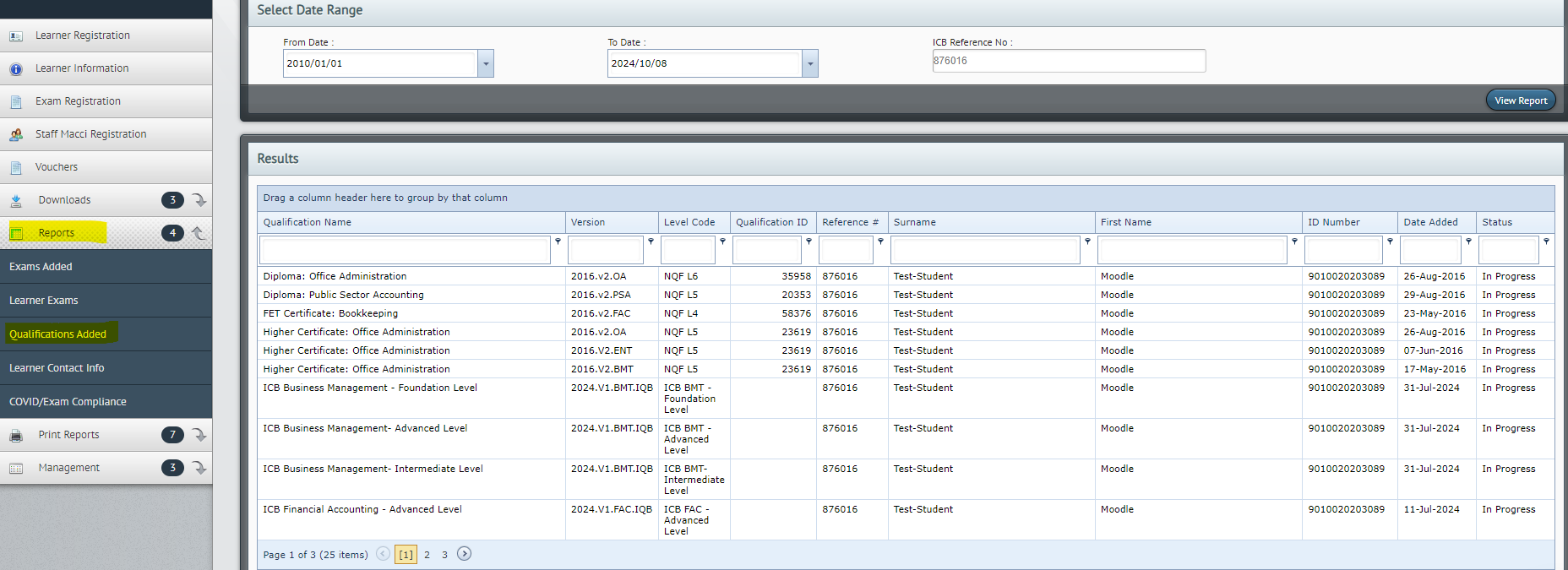
If you are a training centre:
Qualifications that a student is registered for are found under Reports, Qualifications tab for bulk and individual searches.
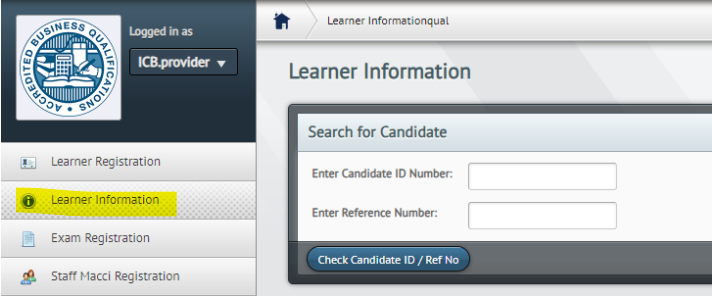
You can also search per student and see a students full record of qualifications and completed subjects under Learner Information
How to understand the Business Literacy Results?
Why is the ICB’s Business Literacy split into three levels, and what must I do if my result is ‘not yet competent’ in any of the levels?
The ICB examines NQF Level 3, 4 and 5 in one subject – one Portfolio of Evidence (PoE) and one final exam.
We’ve bundled the three levels into one subject, so that the PoE content and the final exam covers all the levels sufficiently.
The benefit is that you only have to enter and pay for one subject, but get accredited at all three levels. This saves you having to complete three separate subjects.
You will get a result for each level. If you fail one of the levels (you are ‘not yet competent’) and would like to rewrite the subject, you will need to complete all three levels again in order to pass the subject.
Example of exam paper


PREVIOUS VS NEW BSL RESULTS BREAKDOWN
Changes have been made to the mark allocation per BUSL level outcome.
- BSL1 (NQF3) result is made up of Section A of the exam paper and is out of 60 marks.
- BSL2 (NQF4) result is made up of Section A and Section B of the exam paper and is out of 120 marks.
- BSL3 (NQF) result is made up of Section C of the exam paper and is out of 60 marks.
The same PoE result is added to all levels for a final result.
NQF vs IQB Pathways
What are the two different certification pathways?
- Students who register from 1 July 2026 onward will follow the IQB pathway, which is internationally recognised but not aligned to the South African NQF framework.
- Students who register before 30 June 2026 will remain on the NQF pathway and must complete their qualifications by 30 June 2029 as planned.
- These dates is subject to change by government legislation and are correct as of 12 March 2025.
- Click here to download a full list of NQF Qualifications offered by ICB
Progression Path
Study Further — with Credit for Your ICB Qualification
You may be eligible for study credit with:
Example: NQF Level 6 ICB qualifications may provide credits at partner institutions. CIMA allows up to 2 credits with an NQF Level 5 Office Administration qualification.
Professional Membership
Post-qualification, you can apply for membership with:
Study Material
- If enrolled with an Accredited Training Centre — your provider will supply all required study material and support.
- If choosing self-study — purchase ICB-approved material from: EDGE Education
Study Options
Whether you prefer to study on your own or with structured support, ICB gives you the flexibility to choose the path that fits your life.
Option 1: Self-Study
Study at your own pace, on your own schedule. Register directly with ICB, choose your subjects, and source your own learning materials. Perfect for motivated, independent learners who want flexibility.
Option 2: Study with a Training Centre
Join an accredited ICB training centre (classroom or online) for structured classes, tutor support, and help with exam preparation. A great option if you prefer guided learning.
Click here for more information on study options
RPL
How long does the RPL process take?
Initial review: up to 6 weeks. If a Portfolio of Evidence (PoE) is required, allow 7–8 weeks for results after PoE submission.
Is RPL available for NQF and IQB pathways?
Yes — but note: NQF credits only apply if you enrolled as an ICB student before 30 June 2026. After that, exemptions apply to IQB Professional Certification (non-credit bearing).
RPL Process
- Step 1: Read the Guidelines for Recognition of Prior Learning
Download and read the official ICB Examination Policy. - Step 2: Create a student profile on the ICB Student Portal
Go to the ICB website, click Student Portal, and register to create your student profile and get your ICB number (no payment needed yet). - Step 3: Pay the application fee
Pay the RPL application fee (see Fees list for correct fee). - Step 4: Submit all required documentation
Submit your full RPL application online and upload the supporting documents;
-Detailed CV
-Transcripts of formal, NQF-registered qualifications
-Proof of accreditation for your previous provider
-NQF level and SAQA qualification registration number for previous courses
-Proof of payment
-Official copies of previous course results
-Copy of ID book / passport (if non-RSA resident)
-Letter from your manager confirming work experience (if applicable) - Step 5: Receive the outcome
Your application will be reviewed by the ICB Exemptions Review Board.
You’ll receive a written decision (allow up to 6 weeks). - Step 6: Accept the outcome & make payment
If credit is granted:-Pay the exemption fee per subject (for full exemption), or
-Pay the RPL fee per subject (for conditional exemption / PoE required) - Step 7: Get access to the RPL PoE (if applicable)
For conditional exemption, you’ll complete a Portfolio of Evidence (PoE) for each subject (via the MACCI portal).
For full exemptions, no PoE is required.
Subject certificates are issued for successfully completed conditional exemptions only, not for full exemptions. Qualification certificates are issued once all requirements for a completed qualification are met.
Summary of RPL Outcomes
- Full exemption granted — exemption fee applies
- Conditional exemption granted — PoE must be completed, exemption fee applies
- Exemption not granted — you will need to complete the subject via normal ICB assessment
What happens if I don’t submit everything up front?
Incomplete applications will not be processed. If you submit late documents, a new application fee will apply and the process restarts.
Where can I get full details?
Download the ICB Examination Policy — or contact support@icb.org.za (Subject: Exemptions).
Who can apply for RPL?
Anyone with NQF-registered qualifications (last 5 years), or relevant work experience aligned to ICB qualification outcomes.
Will I get a subject certificate for exempted subjects?
Subject certificates are issued for successfully completed conditional exemptions only, not for full exemptions.
Qualification certificates are issued once all requirements for a completed qualification are met.